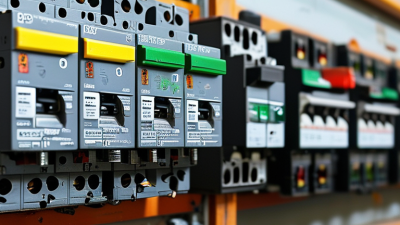
| Insulated Housing |
Heat-resistant, electrically insulating molded enclosure |
Protects internal parts and prevents accidental contact with live electrical components |
Contains heat, mechanical movement, and the arc produced when the contacts open |
| Line and Load Terminals |
Metal connection points secured by terminal screws or clamps |
Connects the MCB to the incoming supply and outgoing circuit conductors |
Maintains a firm electrical connection while the breaker carries normal load current |
| Fixed Contact |
Stationary conductive contact, commonly made from an engineered copper-based contact material |
Provides one half of the main current path |
Separates from the moving contact when the trip mechanism operates, interrupting current flow |
| Moving Contact |
Spring-loaded conductive contact linked to the operating mechanism |
Opens or closes the circuit during switching and tripping |
Moves rapidly away from the fixed contact to disconnect the circuit during an overload or short circuit |
| Thermal Trip Element |
Bimetallic strip formed from two metals with different expansion rates |
Detects sustained overcurrent, such as an overload |
Excess current heats and bends the bimetallic strip. After a time delay, it releases the trip mechanism |
| Magnetic Trip Element |
Electromagnetic coil with a movable plunger or armature |
Detects very high current caused by a short circuit |
The strong magnetic field pulls the plunger almost instantly, releasing the mechanism and opening the contacts |
| Trip Mechanism |
Mechanical latch, lever, and spring assembly |
Converts a thermal or magnetic trip signal into contact separation |
Releases stored spring energy so the contacts open quickly and independently of the handle position |
| Operating Handle |
Manual ON, OFF, and reset control |
Allows the user to energize, isolate, or reset the circuit |
After the fault is cleared, the handle can be moved to the reset position and then switched on again |
| Arc Chute |
Stack of insulated metal plates or arc-splitting elements |
Controls and extinguishes the electrical arc formed as the contacts separate |
Divides and cools the arc, increasing its length until it can no longer sustain current |
| Arc Runners |
Conductive guides positioned near the contacts and arc chute |
Directs the arc away from the contact surfaces |
Uses electromagnetic forces generated by fault current to move the arc into the arc chute |
| Operating Spring |
Preloaded mechanical spring connected to the contact mechanism |
Provides rapid contact movement during switching and tripping |
Releases stored energy to open the contacts quickly, helping limit fault duration |
| Trip Indicator |
Mechanical position indicator or handle position marker |
Shows whether the breaker is ON, OFF, or tripped |
Helps distinguish a fault trip from a manually switched-off condition, depending on the design |
| Rated Current |
Continuous current value the MCB is designed to carry under specified conditions |
Defines the circuit's normal operating current limit |
If current remains above the rated level, the thermal element eventually trips the breaker |
| Number of Poles |
Single-pole, double-pole, three-pole, or four-pole configurations are commonly available |
Determines how many circuit conductors are switched and protected |
All connected poles operate through a linked mechanism so the required conductors disconnect together |
| Tripping Characteristic |
Common curves include B, C, and D, each with a different instantaneous magnetic-trip range |
Matches the breaker to the expected inrush current of the connected load |
The magnetic element trips at a current range determined by the selected characteristic, while overload protection remains time-dependent |